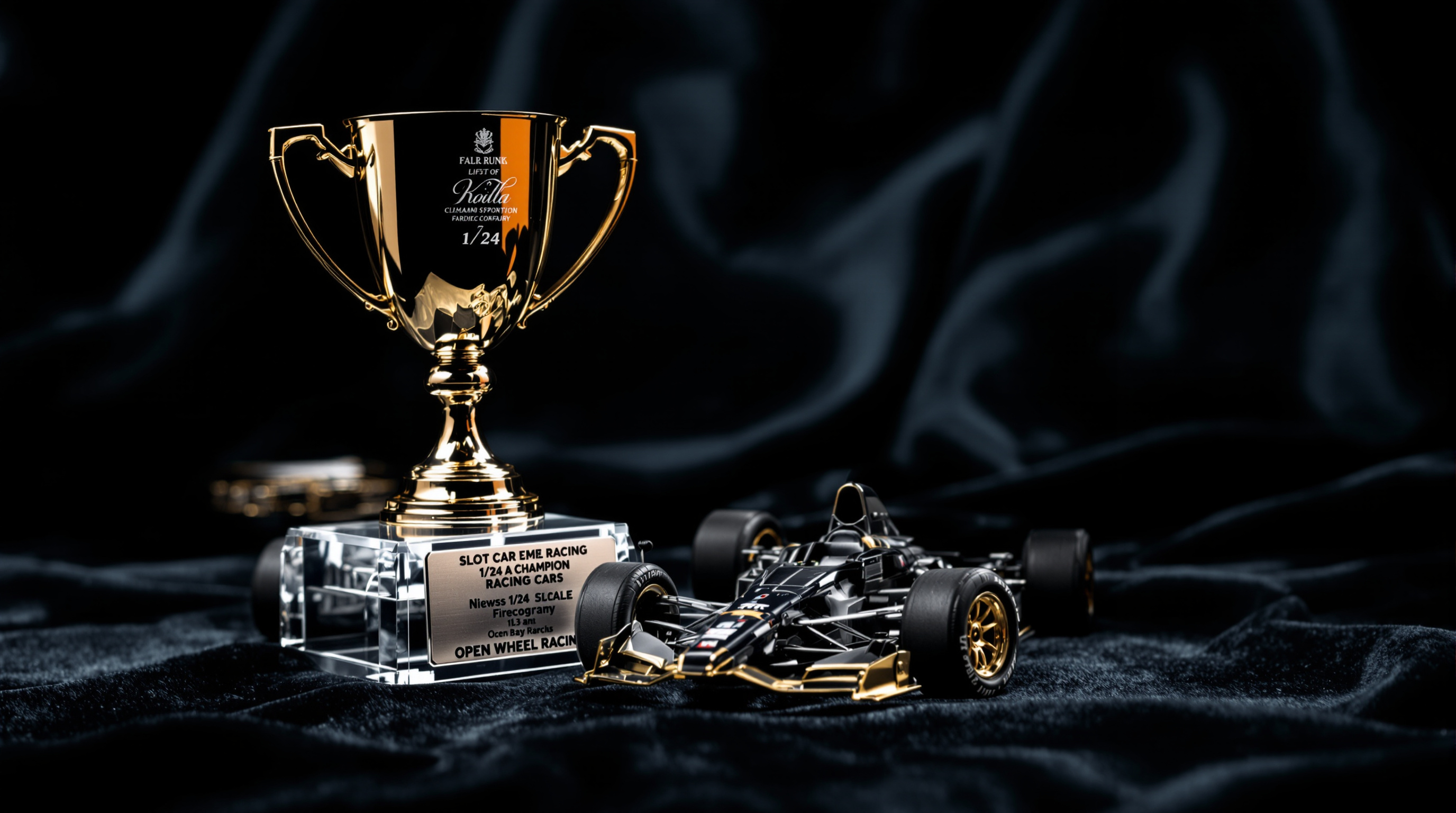
The World's Premier Slot Car Title
The slot car World Championship stands as the pinnacle of international competitive racing in miniature. First contested in 1978 under the auspices of the early international governing structure, the championship was formalised and expanded when IMCA — the International Model Car Association — was founded in December 1985. That founding agreement between the world's leading national federations established a unified competition framework, a standardised three-class structure, and the IOC points rating system that would govern championship allocation for the following three decades.
IMCA championships are contested across three recognised classes: the G7 open-wheel wing car (1/24 scale), the ES24/ES32 scale touring cars, and the PlaFit model car class. The World Championship is most prominently associated with the G7 wing car — the fastest and most technically demanding of the three — but world titles have been awarded across all classes throughout the IMCA era.
G7 Wing Car World Champions — All-Time Records
The G7 wing car championship is the headline event of every World Championship meeting. These 1/24 scale open-wheel cars, equipped with powerful in-line motors and broad aerodynamic wings, represent the absolute performance ceiling of slot car technology. Driving one at competition pace requires exceptional throttle sensitivity and track awareness built over many seasons of practice.
| Year | Champion | Nation | Notes |
|---|---|---|---|
| 1978 | Joel Montague | USA | Inaugural G7 World Champion |
| 1980 | Paul Pfeiffer | USA | First of four titles |
| 1982 | Paul Pfeiffer | USA | Dominant back-to-back run |
| 1984 | Paul Pfeiffer | USA | Third title in four championships |
| 1986 | Lasse Äberg | Sweden | First European G7 World Champion |
| 1987 | P-A Watson | Sweden | Swedish back-to-back |
| 1988 | Mike Swiss | USA | US title return |
| 1989 | Stuart Koford | USA | Future equipment innovator |
| 1990 | Mike Swiss | USA | Second world title |
| 1991 | P-A Watson | Sweden | Second world title |
| 1993 | Jon Laster | USA | Champion at San Jose, CA |
The Three-Class Championship System
One of IMCA's most significant contributions to competitive slot car racing was the formalisation of a three-class championship structure. Rather than reducing the sport to a single specification, IMCA recognised that different disciplines attracted different types of racers — and that the health of the hobby depended on catering to all of them.
The G7 wing car class targets the purist performance racer. Vehicles are 1/24 scale open-wheel machines with prominent aerodynamic wings, inspired by the American oval racing tradition. Motor technology in this class has always pushed the limits of what magnet-wound and hand-wound motors can deliver, and preparation is an art form in itself.
The ES24 and ES32 scale car classes use Lexan polycarbonate bodies over high-performance pan chassis, replicating the silhouette of real touring cars. DTM liveries, NASCAR bodies, and various GT car shells are common, making the pitlane visually spectacular alongside the raw performance engineering underneath.
The PlaFit model car class is widely regarded as the most demanding from a craftsmanship perspective. Using hard plastic, resin, or GFK (fibreglass-reinforced polymer) true-scale bodies, these cars must look as well as go — and judges penalise imperfect preparation. Championship-level model car racers invest enormous time in bodywork, painting, and detailing.
Championship Distribution by Federation
A total of 58 IMCA-era World Championship titles have been distributed across the sport's major national federations, reflecting the genuinely global reach of competitive slot car racing:
| Federation | Championships Won | Primary Nations |
|---|---|---|
| IMCA (USA) | 29 | United States |
| ISRA (International) | 10 | Multiple nations |
| USRA (USA regional) | 9 | United States |
| ESRAC/ESROC (Europe) | 6 | European nations |
| NPRA (Nordic) | 3 | Nordic countries |
| UES (European) | 1 | Europe |
The dominance of North American federations in the overall count reflects both the depth of the American club scene and the early establishment of US-hosted championship meetings. However, European participation grew substantially through the late 1980s and 1990s, and the European Championship series (EuroNats) developed into a fiercely competitive parallel programme.
Where the Liveries Came From
The championship records above capture who won, but not what the cars looked like on the grid. In the ES24/ES32 and PlaFit classes especially, a championship entry was a reproduction of a specific real racing car, and choosing that subject was part of the competitive craft — a famous livery is judged against every photograph a scrutineer has ever seen, while an obscure one has to be documented before it can be defended.
That pushed the membership into serious motorsport research, and the results are indexed in the club's Racing History Archive: the endurance classics at Le Mans, Spa and the Targa Florio, the Porsche, Ferrari, Matra and Lola prototypes of the 1960s and 1970s, and the later Group 5, Group C and Japanese GT eras that supplied the model car class with much of its subject matter.
The 1985 Founding Agreement
December 1985 marks the formal birth of IMCA as the sport's international governing body. Representatives from the leading national associations convened to ratify a founding agreement that established standardised technical regulations, a points system for ranking international performance, and a calendar structure that would allow national champions from across the globe to compete under consistent rules.
The agreement's lasting achievement was the creation of the IOC (International Organisation Committee) points system — a graduated scale awarding 20 points to the winner down to 1 point for tenth place — which gave every IOC-rated international event a consistent weighting and allowed meaningful annual rankings to be compiled across dozens of events on multiple continents.
For in-depth discussion of individual championship results and historical records, the international slot car community maintains extensive archives at SlotForum.com, the world's largest online resource for competitive and hobby slot car racing.