Origins in the 1950s
The roots of modern slot car racing reach back to the mid-1950s, when several toy manufacturers began experimenting with electrically powered miniature cars running in guide channels — or "slots" — cut into a track surface. The concept was elegant in its simplicity: a metal pin on the underside of the car engaged with a narrow slot in the track, keeping the car in lane while drawing electrical power from rails embedded in the slot floor. A hand-held controller varied the resistance in the circuit, giving the driver speed control.
The pivotal commercial moment came in 1957, when the British company Minimodels Ltd introduced Scalextric — a brand name that would become so synonymous with the hobby that many people use it generically to describe slot car racing regardless of manufacturer. Scalextric's interlocking plastic track sections, paired with die-cast and later plastic car bodies, made the concept accessible to home consumers at a price point that fuelled rapid adoption across the UK and then Europe.
Other manufacturers followed quickly. In the United States, companies including Aurora, Revell, and Monogram introduced their own competing systems, while in Germany, Carrera established a slot car line that would grow into one of the world's most respected and enduring brands. By the late 1950s, slot car racing had established itself as a significant consumer category.
The 1960s: Commercial Raceways and the First Boom
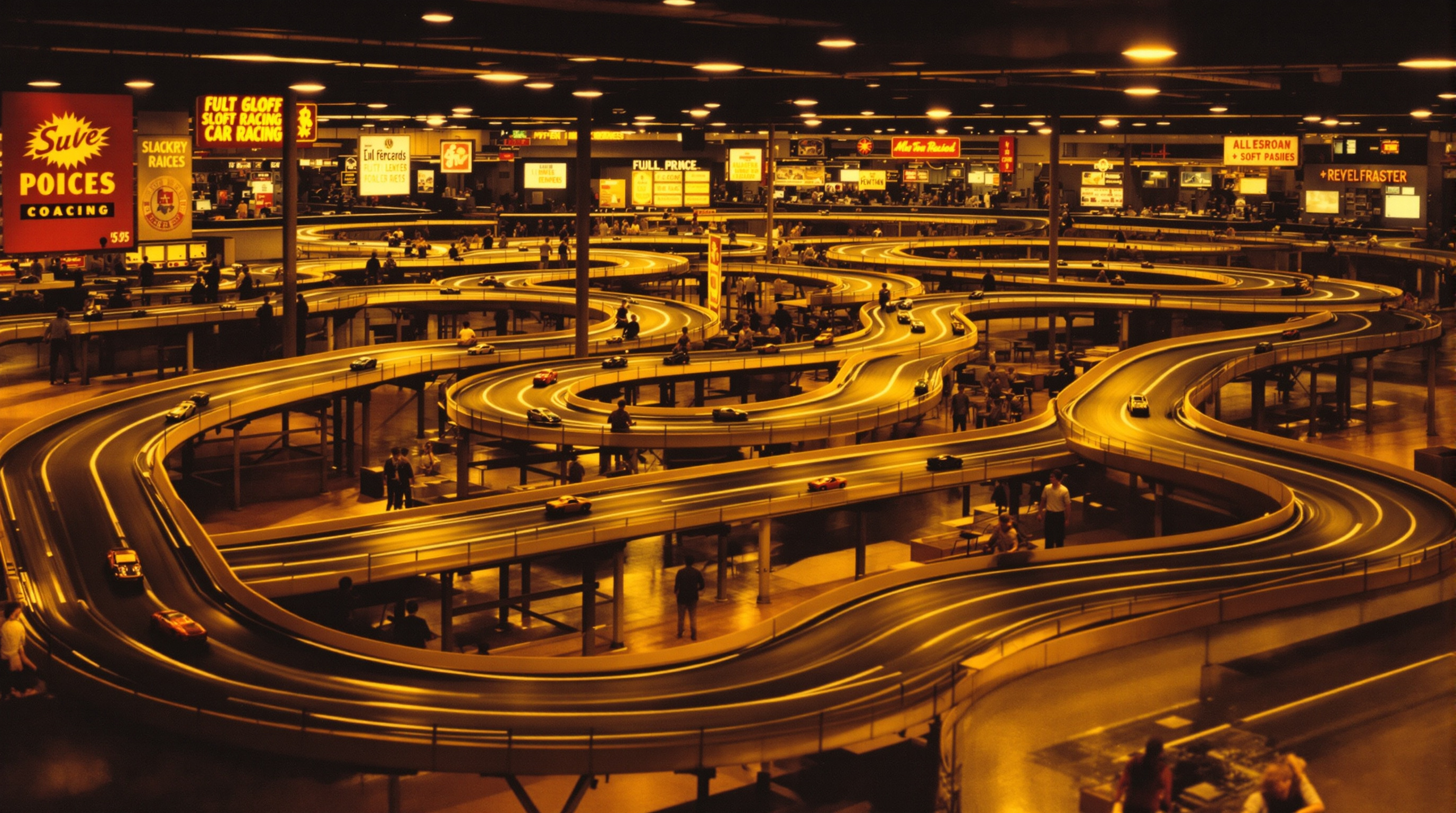
The early 1960s brought the first great explosion of slot car racing. Commercial raceways — purpose-built facilities with large, multi-lane tracks, equipment rental, and organised racing programmes — opened across the United States, the UK, and Western Europe in extraordinary numbers. At the peak of the commercial raceway boom in the mid-1960s, there were estimated to be several thousand operating raceways in the United States alone.
These facilities were a social phenomenon as well as a sporting one. A well-run commercial raceway would be busy every evening of the week, with league nights, junior racing programmes, open practice sessions, and weekend tournaments drawing large crowds. The combination of accessible technology, competitive racing formats, and the social atmosphere of a sports venue proved highly appealing.
The 1960s raceway culture also catalysed the first serious technical development of slot car equipment. As racing became competitive, enthusiasts began modifying factory-produced cars to improve performance — rewinding motors, fitting different tyres, adjusting chassis geometry. The practice of car building as a skilled discipline in its own right began in these commercial raceway settings.
By the late 1960s, however, the commercial raceway boom was in decline. Competition from other leisure activities, changing consumer tastes, and the natural exhaustion of a trend saw thousands of raceways close across North America. The hobby did not disappear — it retreated into its natural constituency of dedicated enthusiasts — but the era of mass-market commercial racing was largely over by 1970.
The 1970s: Club Consolidation and the First Championships
The 1970s saw slot car racing reconsolidate around a smaller but more committed community of serious hobbyists. Across the US, UK, Europe, and beyond, local clubs formed around purpose-built routed wooden tracks — hand-crafted race surfaces with professionally routed slots and carefully finished racing lines that offered far superior performance to the plastic consumer tracks that had served the commercial raceway era.
National federations began to take shape during this decade, providing the organisational infrastructure necessary to run consistent championship series and establish technical standards. The British Slot Car Racing Association (BSCRA), established during this period, became one of the world's most influential governing bodies for the sport.
The era's defining competitive moment came in 1978, when the first G7 Wing Car World Championship was contested. Joel Montague of the United States took the inaugural title, establishing a precedent for international championship competition that would define the sport's aspirations for the following three decades. The 1978 championship demonstrated that slot car racing had the organisational capability and competitive depth to sustain world-level events.
Paul Pfeiffer and Early Dominance
The early championship years were defined by the extraordinary performance of Paul Pfeiffer, who claimed three G7 World Championships in 1980, 1982, and 1984. Pfeiffer's dominance during this period was total — his combination of superior equipment preparation and exceptional driving skill set a standard that would not be matched until well into the IMCA era. His legacy extends beyond the championship trophies: the preparation techniques he developed influenced G7 car building practice for a generation.
December 1985: The IMCA Founding Agreement
The formal structure of modern international slot car racing was established in December 1985, when representatives from the world's leading national federations convened to ratify the IMCA founding agreement. The International Model Car Association was constituted as the global governing body for competitive slot car racing, with authority to sanction world championships, European championships, and the international calendar of IOC-rated events.
The founding agreement's most lasting achievement was the establishment of a unified technical and competition framework. Standardised class regulations, the IOC points rating system, and a common calendar structure gave clubs and federations across the world the certainty needed to invest in long-term competition programmes. The December 1985 agreement transformed international slot car racing from a loosely connected series of national events into a genuinely governed global sport.
The IMCA Era: 1985–2012
Under IMCA governance, international slot car racing entered its most structured and technically advanced phase. The period from 1985 through the early 2010s saw world championship events staged on multiple continents, the European Championship series (EuroNats) develop into a fiercely competitive parallel programme, and a sustained programme of technical innovation that transformed the performance ceiling of all three recognised classes.
The late 1980s and 1990s brought a wave of European success. Lasse Äberg of Sweden became the first European to win the G7 World Championship in 1986, ending the North American dominance of the early championship years. His three consecutive European titles confirmed Sweden as a G7 superpower, and European performance across all classes reached parity with and often exceeded the American standard during this period.
Stuart Koford's 1989 World Championship title marked the beginning of another important chapter: Koford went on to become one of the most influential equipment manufacturers in the sport, his motor and chassis products shaping G7 racing for years after his competitive career.
The Real Racing Behind the Models
Running alongside the competitive history above was a research culture that is easy to overlook. Because the ES24, ES32 and PlaFit classes required bodies modelled on real cars, serious builders became amateur motorsport historians by necessity — establishing which chassis ran which livery at which event, and which details changed between rounds of a season. Club magazines and newsletters carried the results of that work as feature articles, race retrospectives and quizzes.
That material is collected in the community's Racing History Archive, which indexes the eras the membership studied most closely: the Targa Florio and the lightweight Porsche 908/03 built for it, the three-litre prototype wars between Ferrari and Matra, the unlimited Can-Am years, the Group 5 silhouette cars and the Group C fuel-formula era, and Japanese GT racing from JGTC through to Super GT.
Legacy and the Modern Hobby
IMCA's active governance period wound down in the early 2010s, but the hobby it nurtured continues to thrive. National clubs and federations across Europe, North America, and beyond maintain active racing programmes, and the community of serious hobbyists who developed their skills during the IMCA era remains engaged and active.
The major commercial manufacturers — Scalextric, Carrera, SCX, and others — continue to develop new products, introducing the hobby to successive generations of newcomers while the club racing community sustains the competitive tradition at its most demanding levels.
The full history of competitive slot car racing, including detailed records from the IMCA era, is documented by the international community at SlotForum.com — the world's most comprehensive online archive and discussion resource for the slot car hobby.