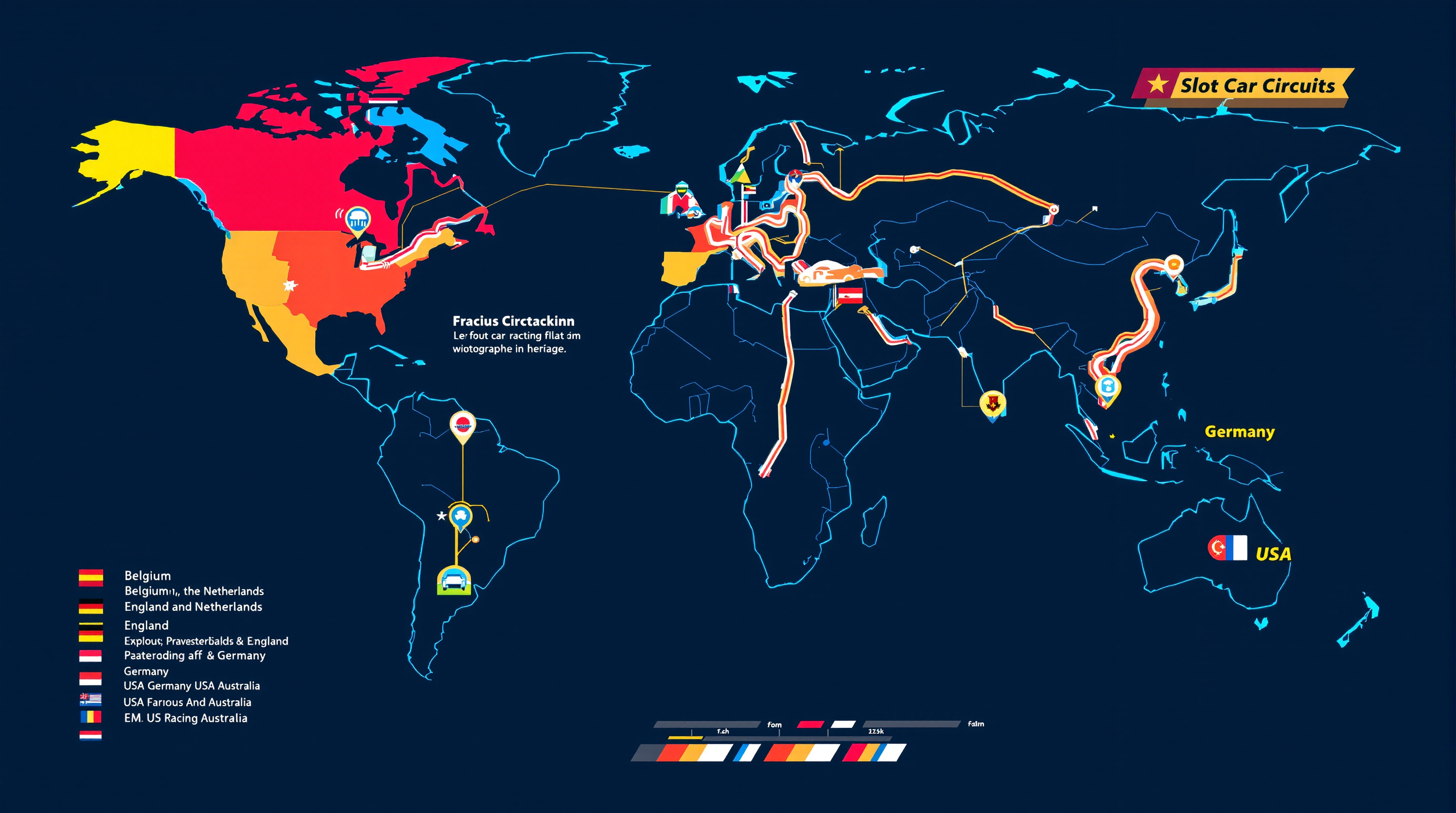
A Truly Global Calendar
One of IMCA's defining achievements as the international governing body for slot car racing was the creation of a genuinely global competition calendar. The IOC (International Organisation Committee) points rating system gave every sanctioned international event a consistent currency value, allowing competitors from different continents to accumulate annual rankings regardless of which events they attended. A racer who competed exclusively in Europe would be ranked alongside one who focused on North American events — and both could be compared with a competitor from Australia or New Zealand who participated in the Southern Hemisphere programme.
This global calendar was ambitious for a hobby sport: it required national federations to coordinate event dates, align technical regulations, and submit results to a central body for points processing. That it functioned as well as it did for nearly three decades is a testament to the dedication of the federation officials and club organisers who made it work.
IOC Points Rating System
The IOC points system was the backbone of international slot car ranking. Applied consistently across all rated events worldwide, it provided a graduated reward for finishing positions that made the annual rankings meaningful:
| Position | Points | Position | Points |
|---|---|---|---|
| 1st | 20 | 6th | 6 |
| 2nd | 15 | 7th | 4 |
| 3rd | 12 | 8th | 3 |
| 4th | 10 | 9th | 2 |
| 5th | 8 | 10th | 1 |
The scale's non-linear structure — with substantial gaps between the top positions and a long tail of modest awards — rewarded outright wins and podium finishes heavily while still acknowledging consistent top-ten performance. A driver who won multiple IOC events in a season would build an insurmountable ranking lead; one who finished consistently in the five-to-eight range would accumulate a meaningful tally without necessarily threatening the top of the table.
European Events
Europe was the heartland of the IMCA international calendar, with more IOC-rated events per season than any other continent. The density of committed club racers, well-equipped routed tracks, and functional national federation infrastructure made Europe the natural centre of international competition.
Benelux Cup (Belgium/Netherlands): The premier annual endurance event in the European calendar — a 12-hour model car race contested in the Belgium-Netherlands region. See the Benelux Cup page for full details on this iconic event.
EEC Championship Rounds: The European Endurance Championship series provided a structured season-long competition framework across multiple rounds staged at venues throughout western Europe. The EEC rounds attracted strong international fields and carried full IOC points allocation, making them important fixtures in the annual calendar.
BSCRA National Championships (United Kingdom): The British Slot Car Racing Association's national championship series was one of the most competitive domestic programmes in the world, and the top-tier BSCRA events carried IOC rating. British racers who excelled at the BSCRA Nationals contributed to the UK's international rankings and earned the credentials to enter continental championship events.
ESROC EuroNats: The European Slot Racing Organisation of Countries (ESROC) coordinated the flagship European Championships — the EuroNats — which were the highest-rated events on the European IOC calendar. See the European Championships page for the full historical record.
MRTU 8-Hours (Uden, Netherlands): The Dutch city of Uden hosted an 8-hour endurance event under MRTU organisation that became a regular and popular fixture on the European calendar. The format — shorter than the Benelux Cup but still a genuine endurance challenge — attracted entries from across the Netherlands and neighbouring countries.
Merlijn 24-Hours (Wezembeek-Oppem, Belgium): A full 24-hour endurance race at Wezembeek-Oppem in Belgium — one of the most extreme events on any slot car calendar anywhere in the world. Completing the Merlijn 24 Hours was an achievement in itself; winning it required mechanical preparation and strategic management of the highest order.
Diepenbeek 24 Hours (Belgium): Belgium's second 24-hour event, staged at Diepenbeek in the Limburg province. The presence of two 24-hour events in a single country reflects the extraordinary depth of Belgian slot car club infrastructure and the local appetite for endurance-format competition.
North America
North American competition was centred on a network of established clubs with routed tracks capable of hosting national and international events. The United States Racing Association (USRA) coordinated the domestic championship structure and managed the relationship with IMCA's international calendar.
USRA National Championships — JK Raceway (McHenry, Illinois): JK Raceway in McHenry was one of the most respected slot car venues in North America, hosting USRA National Championship events across multiple class divisions. The facility's well-maintained routed track and serious club membership made it a natural home for the sport's highest domestic events.
USRA National Championships — Port Jeff Raceway (Coram, New York): The Port Jefferson Raceway in Coram on Long Island provided the eastern US hub for national championship competition. The New York area's large population of committed slot car racers and the track's excellent facilities made Port Jeff a regular championship venue throughout the IMCA era.
F-2000 Nationals — Lucky Bob's Raceway (Milwaukee, Wisconsin): Lucky Bob's Raceway in Milwaukee hosted the F-2000 class national championship, catering to one of the sport's specialist categories. The Milwaukee club's long tradition of competitive racing and well-organised events earned it a permanent place on the national calendar.
Southern Hemisphere
IMCA's reach extended to the Southern Hemisphere, where Australia maintained an active competitive programme under its own national federation structure.
Australian G-7 Nationals — King Willy's Raceway (Williamstown, Melbourne, Victoria): King Willy's Raceway in Williamstown, the bayside Melbourne suburb, served as the home of Australian national championship G7 racing throughout the IMCA era. The facility's reputation for serious competition and well-prepared Australian racers — some of whom competed at world and European championship level — made the Australian Nationals a respected fixture on the global calendar.
For detailed event histories and current information on international slot car competition, the global community at SlotForum.com maintains comprehensive archives and active discussions covering both historical and contemporary events.