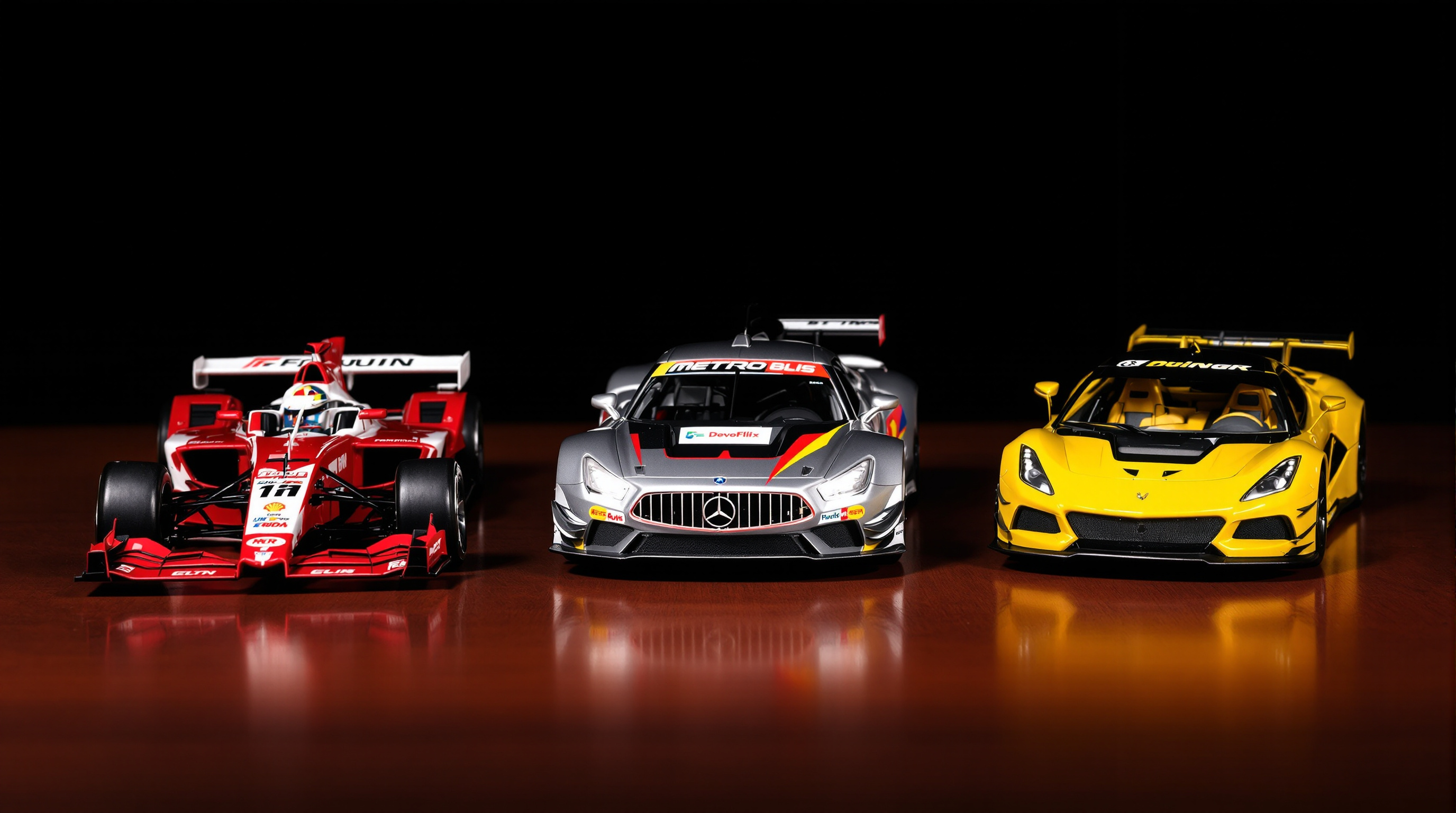
Three Classes, Three Disciplines
One of IMCA's most important structural decisions was the adoption of a three-class championship framework. Rather than forcing the entire international field to compete in a single specification, IMCA recognised that slot car racing had developed along genuinely different lines in different countries and communities — and that the sport's global health depended on accommodating those differences within a common competitive structure.
The three classes each reward a different type of racer. G7 rewards pure performance engineering and throttle finesse. ES32 blends technical preparation with visual presentation. PlaFit model cars demand the patience and craftsmanship of a model maker alongside genuine driving ability. Together they make IMCA competition accessible to a far wider range of participants than any single-class structure could achieve.
G7 Wing Cars — The Performance Class
The G7 wing car class is the headline act of international slot car competition — fast, spectacular, and technically unforgiving. These are 1/24 scale open-wheel racing cars equipped with broad aerodynamic wings inspired by North American oval racing, particularly the Indy car and sprint car traditions. A championship-specification G7 car is a piece of precision engineering: every component from the guide pin to the rear axle is selected, matched, and balanced with exacting care.
At the heart of every G7 car is the motor — typically a powerful in-line design, either magnet-wound for consistency or hand-wound for maximum output. Motor preparation is a highly specialised skill, and the best motor builders in the sport are known by name across the international community. Chassis are typically hand-fabricated from piano wire or flat steel, tuned to the specific banking, traction, and surface conditions of the track where they will race.
Driving a G7 car at competition pace requires exceptional throttle sensitivity. Too much power too early and the car breaks traction and slides out of the slot; too little and lap time evaporates on the straightaways. The controller — a hand-held variable resistance device — becomes an extension of the driver's instinct after years of practice, and the difference between championship-winning throttle management and a mid-field finish can be imperceptible to the untrained eye.
The G7 class has produced slot car racing's most celebrated world champions, including Paul Pfeiffer's three consecutive titles, Lasse Äberg's European dominance, and Stuart Koford — whose later work as an equipment manufacturer would shape the G7 class for decades after his 1989 championship win.
ES24 and ES32 Scale Cars — The Touring Class
The ES24 and ES32 scale car classes use Lexan polycarbonate bodies over high-performance pan chassis, replicating the silhouettes of real-world touring cars at 1/24 and 1/32 scale respectively. DTM (Deutsche Tourenwagen Masters) liveries, NASCAR stock car shells, and various GT racing bodies are all common in this class, making the ES32 pitlane one of the most visually striking sights in competitive slot car racing.
The polycarbonate Lexan body — the same material used in full-size racing car windows — is transparent before painting, which means the driver applies paint from the inside, working in reverse. A championship-quality ES32 body may require dozens of masking operations and multiple colour layers to achieve the sponsor liveries and colour schemes of the original racing car being replicated. This combination of artistic skill and mechanical preparation is central to the class's appeal.
Underneath the bodywork, the ES32 pan chassis shares many performance characteristics with the G7 class. Motor selection, traction management, and guide pin tuning are all critically important. However, the additional weight and aerodynamic constraint imposed by the enclosed body changes the handling balance significantly, and ES32-specific setup knowledge is a discipline in its own right.
The scale car classes have traditionally served as an important bridge between hobby racing and international competition — the familiar body shapes and more accessible entry costs making it easier to get started compared to the fully bespoke G7 category.
PlaFit Model Cars — The Craftsmanship Class
The PlaFit model car class is widely regarded as the most demanding in the IMCA championship portfolio — not necessarily in terms of outright speed, but in the breadth of skills required to field a competitive entry. PlaFit cars use hard plastic, resin, or GFK (fibreglass-reinforced polymer) true-scale bodies, meaning the car must look as close to its real-world counterpart as a skilled modeller can achieve. Scrutineers at championship level assess not just mechanical compliance but the quality of the bodywork, paint, and detail.
A championship-level model car racer is simultaneously a skilled slot car engineer and an accomplished scale modeller. Bodies must be prepared, filled, primed, and painted to a finish that would not look out of place in a competitive scale modelling exhibition — and then that carefully crafted body must survive the rigours of competitive racing on a routed wooden or plastic track at speed.
This class has historically attracted racers who came to slot car competition through the scale modelling hobby, bringing with them advanced techniques in body preparation and painting. Vladimir Horky of the Czech Republic — the all-time leader in European Championship wins — built much of his extraordinary record in the model car class, where Czech preparation standards became the international benchmark.
Choosing a Subject: Research as Part of Preparation
In the two body-based classes the work begins before any component is fitted. A scale entry is a reproduction of a particular car as it appeared at a particular event, and the choice of subject shapes everything that follows — the shell that has to be sourced, the colours that have to be mixed, the sponsor decals that have to be found or made, and the reference photographs a finished car may be held against. Experienced builders treat subject research as a preparation stage in its own right, on a par with chassis setup.
It is also where much of the hobby's character comes from. The community accumulated a substantial body of motorsport-history research in the course of choosing and defending its subjects, indexed in the club's Racing History Archive — from the Targa Florio and the Porsche 917 through the Can-Am and Group C to JGTC and Super GT.
IOC Points Rating System
All IMCA-sanctioned international events were rated under the IOC (International Organisation Committee) points system, which provided a consistent currency for ranking drivers' international performance across events staged on multiple continents. Points earned at IOC-rated events accumulated toward annual international rankings and contributed to championship qualification.
| Finishing Position | IOC Points Awarded |
|---|---|
| 1st | 20 points |
| 2nd | 15 points |
| 3rd | 12 points |
| 4th | 10 points |
| 5th | 8 points |
| 6th | 6 points |
| 7th | 4 points |
| 8th | 3 points |
| 9th | 2 points |
| 10th | 1 point |
The graduated points scale rewards consistency across events — a driver who regularly finishes in the top five at IOC-rated events worldwide will accumulate a stronger annual ranking than one who achieves occasional high finishes. This structure encouraged international travel and participation across the full calendar rather than focusing preparation solely on the championship events.
For detailed technical regulations, equipment specifications, and class history, the international slot car community at SlotForum.com maintains comprehensive archives. For those interested in getting into the sport, Scalextric provides an excellent entry point into 1/32 scale racing with widely available track and car systems.